

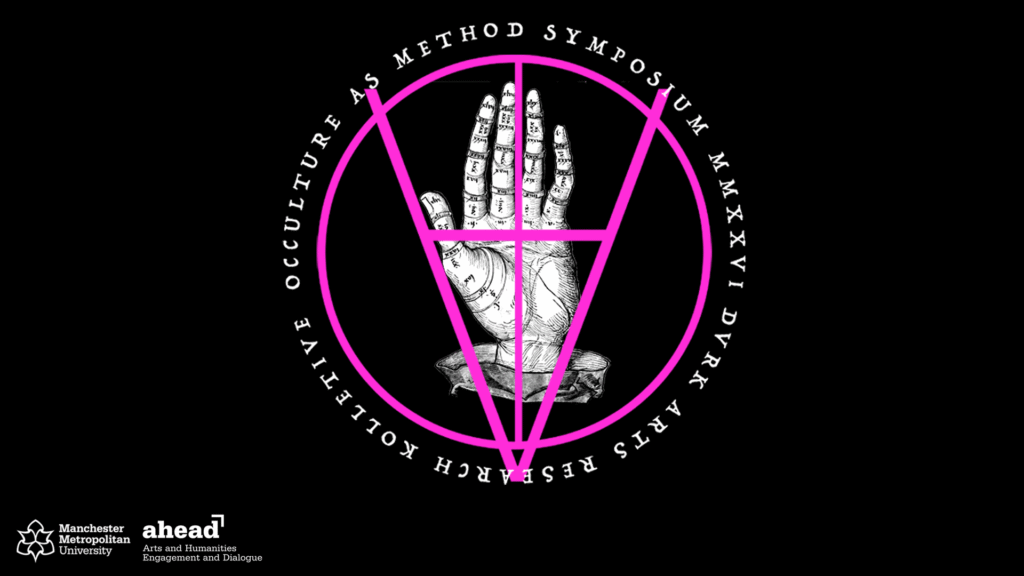
Occulture as Method Symposium
September 10-11, 2026
Manchester Metropolitan University / SODA (location)
Event booking link / Symposium Programme PDF link
Thursday 10th September Programme:
0900 / Registration
09:45 / Welcome
10:00 / Panel 1: Research Methods for Occultural Experiences (SODA Cinema)
- Phil Legard / Creative Seekership: Occultural Autoethnography in Theory and Practice
- Jeff Howard / “A Species of Fire”: Phenomenological Approaches to Occultural Gnosis
- João Ferreira / Rituals as Psychophysiological Technologies: A Review of Occult Practices in Experimental Research and Health Applications
11:30 / Break
12:00 / Workshop Session 1
- Fabrizio Cocchiarella and John Lloyd / Let’s Talk About Death (SODA Reception)
- Chris Gladwin / Runic Acid Glyph Workshop (SODA 1.13)
- Maya Chowdhry and Hannah Singleton / Electro Magnetic Coven (SODA 4.06)
13:00 / Lunch
14:00 / Panel 2: Sociopolitics of Occulture
- Stefano Pavarini / Deconstructing Extremism: The Semiotics of Esotericism, Art, and Subcultural Co-optation in Contemporary Neo-Nazism
- Mikkel Rørbo / Digital Occultism as Red-String Method
- Jamie Stephenson / “I Was an Angel, Though Plummeting”: Sonic Occulture in Ethel Cain’s Perverts
15:30 / Break
16:00 / Workshop Session 2
- Matteo Polato / Electronic Voice Phenomena and DIY Radio Making (SODA 1.09)
- Maya Chowdhry and Hannah Singleton / Electro Magnetic Coven (SODA 4.06)
19:00 – 22:00 / Evening social at Impiety Hour (location) with Live Music
- The Universal Veil
- The Wyrding Module
Friday 11th September Programme:
10:00 / Panel 3: Queer, hybrid and subversive occultures (SODA Cinema)
- Cavan McLaughlin and Elizabeth Tomos / Crossing Over as Method: Mapping an Emergent Methodology for Occultural Studies
- Kate Fox / Tarot and the I Ching as Neuroqueer Knowledge Practices
- Jaqueline Woroniec / The Satanic Queer: Morphing Performance of Satan in Popular Culture
11:30 / Break
12:00 / Workshop Session 3
- Fabrizio Cocchiarella and John Lloyd / Let’s Talk About Death (SODA Reception)
- Chris Gladwin / Runic Acid Glyph Workshop (SODA 1.13)
13:00 / Lunch
14:00 / Panel 4: Occultural Hermeneutics
- Fionna Barber / Goddessness as method for feminist critical practice: Jesse Jones’ Mirror Martyr Mirror Moon (2024)
- Ali Darvishi / Interiority as Method: Inside, Fana, and Cinematic Becoming in Soore Vahe’s Between Two Words
15:00 / Break
15:15 / Roundtable: future projects and collaborations
16:30 / Social, upstairs at The Salutation
Esotericism, alternative spiritualities, and the occult, have increasingly been recognised in academic work as significant cultural forces that shape histories, aesthetics, and ways of knowing. Given the peculiar specificities of the esoteric studies field, new methods of inquiry have been formalised by scholars identifying the value of a more direct involvement with the field of study, beyond textual analysis alone (Otto, 2026; Howard and Patterson, 2024; Crockford and Asprem, 2018). Here, the occult is not only studied but experimented with, experienced and reflected upon as part of the research process.
‘Occulture as method’ is a provocation that underpins this symposium. The event seeks to explore these new and emerging types of scholar-practitionership in three principal ways. First, we wish to explore how occult epistemologies and ways of doing have, and can be, mobilised in the creative practices of (for instance) filmmaking, performance, and the visual or sonic arts. Second, we wish to examine how occult practices and worldviews can be used as experimental techniques that supplement or even displace ‘traditional’ social-scientific methods while researching both occult and non-occult phenomena. Third, we wish to investigate how occultural practices and knowledges, often based on intuition, correspondences, and other non-deterministic approaches, may be used to generate alternative, non-dualistic, or marginalised identities, ways of knowing and imagined futures.
Occulture as Method will open a space for critical and experimental reflection on how occult practices and esoteric philosophies can be employed as creative research methods, understanding their opportunities, applications and limits. While the Western world embraces – and often weaponises – procedures of classification, tokenisation and quantification, how can the diverse epistemologies of the dark arts imagine or generate new worlds, and ways of doing and thinking that celebrate that which escapes and that which is hidden?